.gif)

.gif)

.gif)








USEFUL INFORMATIONS
WEATHER
Rangiroa and Tikehau benefit throughout the year from a warm sub-tropical climate,cooled by the trade winds.
The temperature averages 28 °C throughout the year, between 26 and 29 °C in water.
PASSPORT
A valid passport or identity card to the French, is required.
Nationals of other countries must provide a return ticket.
HEALTH
No vaccinations are required to stay on Polynesian territory.
Mosquito lotions and creams are recommended.
BAGAGES
Air Tahiti (vols locaux)
http://www.airtahiti.aero/faq.php?cat=Bagages
Theoretically, the deductible is 10kg between islands. You will enjoy an additional franchise 5kg on presentation of diving certification. The excess risk of you being charged according to a bit of the mood of the attendant.Luggage airport Faaa and some pensions on request. Paid service.
Air France (domestic flights)
www.airfrance.fr/FR/fr/local/guidevoyageur/pratique/bagage_en_soute.htm
Air Tahiti Nui (international flights)
pf.airtahitinui.com/air-tahiti-nui-reglementation-bagages.html
DIVING REGULATION & INSURANCE
- 20 meters (66 feet): maximum depth for certified divers (level 1) FFESSM, FSGT, SNMP, ANMP, CMAS *, open water and advanced PADI, NAUI et SSI.
- 30 meters (approx.98 feet): maximum depth for PE 30 divers
- 40 meters (approx.131 feet): maximum depth for certified divers (level 2) FFESSM, FSGT, SNMP, ANMP, CMAS **, rescue diver PADI, NAUI et SSI.
- 50 meters (164 feet): maximum depth for divers with level of 3 and above.
MARINE WILDLIFE OF FRENCH POLYNESIA
Here is a glimpse of the underwater fauna present in Rangiroa and Tikehau, as well as some information on Rurutu humpback whales.


Plongée au Raie Manta Club
Découvrez la faune de Polynésie
Textes et Photos

Livia et son Dauphin


Le tursiops
Melon convexe, bec court (8 cm), très prognathe. Sourire "craquant". De 18 à 26 dents coniques par demi-machoires. Aileron en faux. Peau grise sur le dos, plus pâle sur les côtés, presque blanche dessous. Clics sur des fréquences de 4000 à 170.00 hertz. Sifflements, couinements. L'espèce vit en petites bandes, qui composent des super-troupeaux de centaines d'individus.
Napoléon
Le plus grand des labres, peut approcher les 200 kg. Lévres épaisses et écailles larges. Yeux très mobiles.les individus en phase terminale développent une bosse frontale proéminente. Ceux en phase initiale sont gris-vertavec deux lignes sombres derrière l'oeil. Les juvéniles sont inféodés aux zones coralliennes riches et très protégées des lagons. Les adultes affectionnent les pentes externes abruptes et les abords des passes. Ils se réfugient chaque nuit dans une cavité du récif à laquelle ils semblent rester fidèles. Les adultes sont solitaires et territoriaux. Peu farouche, il suit volontiers les plongeurs.


Raie manta
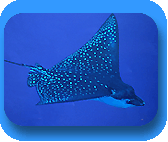
Les yeux sont latéraux et précédés de 2 appendices souples qui, lorsqu'ils sont déployés, servent à canaliser le plancton vers leur gueule.présence de minuscules dents sur la machoies inférieure. Aiguillon absent. Elles sont ovovivipares. A l'issue d'une gestation de 13 mois, elles donnent naissance à 1 ou plus souvent 2 juvéniles de 1,20 m d'envergure pour un poids de 45 kg env. Les adultes croisent solitaires ou en petits groupes le long de la pente océanique et dans les lagons.ils affectionnent les passes où ils trouvent de la nourriture en abondance. Elles stationnent régulièrement à proximité du fond pour se faire déparasiter par les labres nettoyeurs.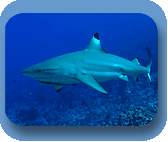
Requin pointe noire
Dos jaune-beige. Ventre blanchâtre. Les extrémités des nageoires sont noires. La dorsale est également marquée d'une tâche blanche qui vient s'insérer à la base de la tâche noire. Le plus commun des requins de Polynésie. Il chasse souvent dans très peu d'eau le long des rivages et sur les hauts platiers. Curieux et peu dangereux.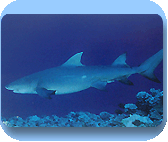
Requin citron
Dos brun à jaune-beige. Le ventre est plus clair que le dos mais reste dans la tonalité générale. Les juvéniles sont de couleur sable. Le museau est arrondi. Les deux nageoires dorsales sont de taille quasi identique. Les adultes affectionnent la pente océanique profonde (80 m). Les juvéniles fréquentent les étendues de sable des lagons peu profonds. Les subadultes se rencontrent dans les sillons du front récifal. Ce requin a mauvaise réputation essentiellement auprès des pêcheurs sous-marins. Tenace, il peut devenir agressif s'il est repoussé.
Requin gris de récif
Requin territorial inféodé aux passes et aux zones de la pente océanique exposées au courant. Présent aussi dans les lagons aux eaux claires, vit en groupe parfois très important. En période de reproduction (hiver austral) ces rassemblements peuvent être forts de plusieurs de centaines d'individus. Celui de Tiputa (atoll de Rangiroa) est connu pour être le plus important de cette espèce. Requin curieux mais distant envers les plongeurs. Néanmoins, il répond très rapidement aux stimuli alimentaires et se départit alors de toute timidité pour devenir "pressant". Il représente dans ce cas un danger non négligeable bien connu des chasseurs sous-marins... Les raira irrités adoptent une nage caractéristique faite de contortions saccadées.


Requin soyeux
Corps très élancé et museau effilé et arrondi. Robe grise aux reflets bronze. Ventre blanchâtre. La première dorsale est courte, à l'apex arrondi. La bordure postérieure de la deuxième dorsale est libre et allongée. Chez les adultes, les pectorales sont longues et effilées. La peau est douce au toucher d'où son nom. Requin pélagique qui s'approche quelquefois des côtes. Généralement solitaire et occasionnellement en petits groupes. Très inquisiteur, ce requin peut s'approcher jusqu'au contact sans mordre toutefois. Potentionnellement dangereux.
Le grand requin marteau
Le corps est massif, doté d'une première nageoire dorsale très haute et falciforme. Le bord antérieur de la tête est légèrement festonné mais presque droit. C'est le plus grand de tous les requins marteaux. Généralement solitaire, il est plus souvent rencontré aux abords des passes où il se déplace près du fond. Pénètre dans les lagons, notamment aux Tuamotus Sa taille et son régime alimentaire en font une espèce dont il convient de se mefier. Potentiellement dangereux.

Requin du récif à pointes blanches
Corps gris à gris-bronze, ventre clair. Toutes les nageoires ont l'apex et la bordure postérieure marqués de blanc. Les adultes se déplacent le long des pentes externes à des profondeurs supérieures à 100 m et remontent rarement sans stimulation alimentaire. Les jeunes individus fréquentent plus volontiers les passes et leur périphérie. Comportement territorial et inquisiteur. Potentiellement dangereux surtout en situation de stimulation

Requin tigre
Museau court et large. L'oeil est rond;la pupille est large et noire. Dos gris rayé de barres verticales sombres plus évidentes chez les jeunes individus. Le ventre est clair, la nageoire dorsale est triangulaire. Une crête rigide court le long du pédoncule caudal. Présent partout le long des pentes océaniques mais rarement observé en raison de son habitat profond (150 à 300 m). Il remonte à la tombée de la nuit et s'aventure dans les passes, les baies et les lagons. Le requin tigre est le seul carcharhinidé ovovivipare. Les portées peuvent être riches de plusieurs dizaines d'individus. Souvent solitaire, parfois en couple. Opportuniste, il a un régime alimentaire varié composé tant d'animaux vivants (tortues, oiseaux, raies, requins, crustacés, etc.) que de charognes. Il est d'autant plus dangereux pour les plongeurs et les nageurs que sa nage lente et assurée ne laisse nullement présager d'une éventuelle attaque.
Baleine à bosse
Le dessus de l’animal est entièrement noir, le dessous est plutôt blanchâtre, le corps massif. Chaque nageoire pectorale peut atteindre jusqu'au tiers de la longueur du corps. Les dessins de la nageoire caudale (noire sur le dessus et blanche en dessous) sont propres à chaque baleine et peuvent servir à son identification individuelle. Les noms français et anglais viennent de la bosse qu’à l’animal à l’avant de la nageoire dorsale.16 à 20 sillons ventraux permettent un très large déploiement de la gueule, les fanons (270 à 400) de couleur sombre sont disposés de chaque côté de la bouche. Les baleines mettent généralement bas tous les deux ou trois ans. La gestation dure onze mois environs, Il est exclusivement allaité par sa mère pendant les six premiers mois. Le baleineau mesure 4 à 5 m pour un poids de 1 à 2 tonnes.Les baleines ne chantent que pendant la saison d’accouplement:on suppose donc qu’il s’agit de chants séduction. Leurs chant sont fait de notes graves Chant des baleines qui varient d’amplitude et de fréquence, en répétant des séquences cohérentes et emboîtées. Elles peuvent chanter pendant des heures, voir des jours entiers. Le chant de la baleine à bosse est aussi réputé que ses sauts et comportements éxubérants. En hiver, pendant la saison des amours, les mâles s'affrontent pour établir leur domination:sauts, dressements verticaux, frappements de l'eau avec les nageoires caudales ou pectorales. Sur les sites de reproduction, on observe souvent des groupes mère-petit, escortés d’un mâle, comme à Rurutu. De plus larges groupes se forment sur les sites de nourrissage.
Comment la reconnaître ? Pour sonder, la baleine à bosse arque fortement son dos et lève sa nageoire caudale à la verticale au dessus de l’eau. Souffle jusqu’à 3 mètres, aussi haut que large.chaque inspiration renouvelle 80% à 90% de l’air contenu dans les poumons du cétacé Seulement 10% à 20% chez la plupart des mammifères terrestres